Storytelling with AI World Models
🧞 Genie 3 Out of the Bottle
A wider release of Genie 3 last week resulted in some impressive demos on X of gameplay generated on the fly, without playing an actual game. Things that even 5 years ago nobody would imagine possible are now becoming reality.
Critics will point out one serious flaw - and it’s not the low frame rate or the high cost, but the lack of persistence. One demo showed how a mountain ledge disappears when you turn your back. For most games, this is untenable - place a vase on a table, turn around, and it should still be there - not transform into a teapot or vanish entirely.
Persistence matters because it maintains the suspension of disbelief required for immersive storytelling. Without it, AI worlds become chaos engines that break reality with every glance. Instead of a coherent experience, you get a whooshing sense of vertigo. This could work well enough in a linear rogue-like game on rails, but it would never reach the richness and depth of the well-crafted worlds we know from literary works.
⛏️ The IP Goldmine
Remember the last time your beloved book series got adapted to TV? Rings of Power, Wheel of Time, The Witcher. How did those turn out? Exorbitantly expensive productions that strayed far from the source material fans loved.
Literally adapting a book scene-by-scene remains too expensive for traditional media. Studios face impossible choices: compress 1,000 pages into 8 hours, change characters to fit modern sensibilities, or invent new plotlines. Each compromise alienates fans who just wanted to see the world they know brought to life.
Games have been somewhat better at respecting the source material - one could, in fact, simply walk into Mordor - but the development costs are still high.
The entertainment industry has long prioritized existing IP over original concepts. AI world generation will continue this - just as the Marvel Cinematic Universe built an interconnected franchise, models like Genie could let fans step into their favorite worlds - without the adaptation compromises.
🐉 Be the Hero in Our Own Story
While the prospect of experiencing our favorite worlds is exciting, the endless stream of remakes recycling the same characters and plots has created much fatigue. Stories need fresh settings, characters, and world mechanics - areas where AAA studios have been struggling.
Smaller developers have stepped into this gap. Games like Stardew Valley, Hollow Knight, and Outer Wilds prove small teams can create rich worlds that rival AAA productions. The indie game market has been growing much faster year-over-year compared to AAA sales. Meanwhile, tabletop gaming has exploded, with D&D 5th Edition reaching 50 million players globally, and actual-play shows like Critical Role drawing millions of viewers and spawning multiple Prime Video animated adaptations.
Creating compelling worlds remains the hardest part of game development. A medieval city of a million, a vast jungle of mysterious ruins, a galaxy of a trillion planets - these require time and resources most creators lack. Procedural generation helped Minecraft and No Man’s Sky achieve scale, but at the cost of story depth.
World models like Genie can help bridge this gap - the scale of procedural generation plus the allure of a captivating story, delivered at the speed of AI. With Vibe Editing, the world emerges before your eyes - mountains shift, cities grow, stars are born with a sentence.
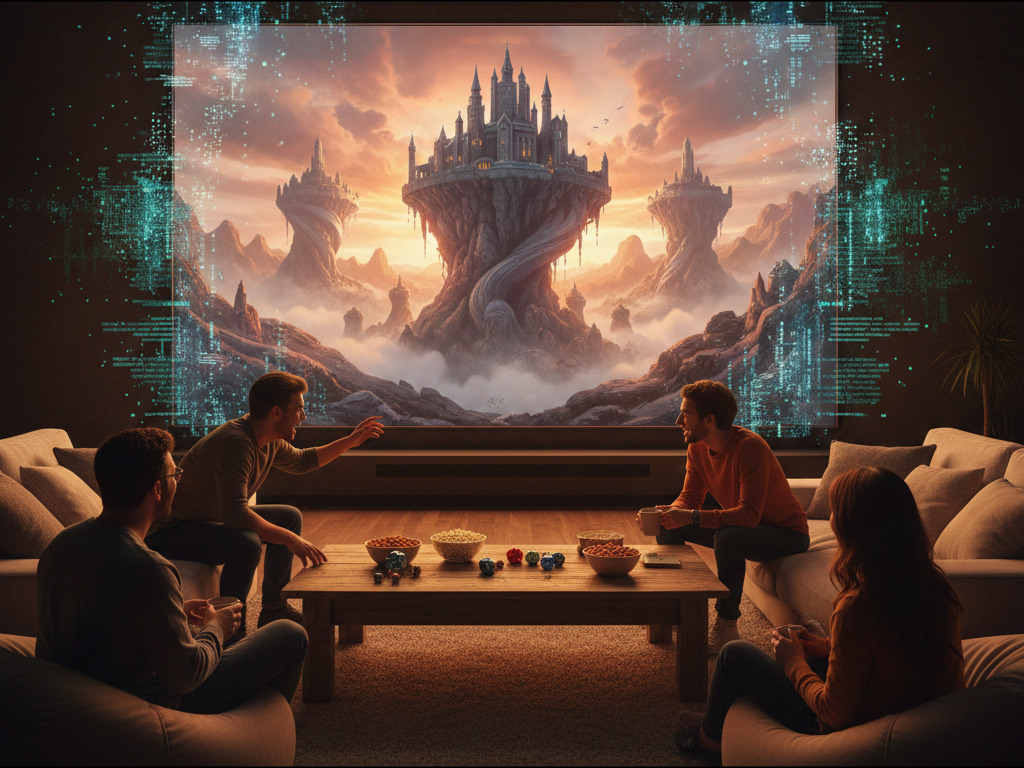
Tabletop Dungeon Masters plug their D&D campaign into an AI model and get a world where landscapes are generated on the fly and the Beholder’s lair adapts to narration as the players battle. This eliminates physical constraints - you can keep rolling dice, but there’s no need to print battle maps and move minis around anymore.
🔥 A Tale Worth Telling
Studios will profit from IP-driven world models - immersive Lord of the Rings experiences, explorable Hogwarts, interactive Star Wars galaxies. But the same technology that enables corporations to mine established IP will democratize world-building for solo creators - provided it is affordable enough.
Today, building a game world requires either a AAA budget or years of procedural system development. Soon, a storyteller with a vision might prototype their setting in an afternoon, iterate through natural conversation with an AI, and export a playable space. An indie developer could compete with the giants on imagination rather than pocket depth.
We’re not there just yet - persistence remains glitchy, costs are high, copyright questions loom. Once we’ve made enough progress on these issues, we can build on a foundation of procedural generation, combined with persistent world models and vibe-editing. The trajectory points toward a future where world-building becomes an act of storytelling once again, not an engineering problem.
And when you have a tale worth telling - get some snacks ready, gather your friends and family, and sit comfortably around the living room screen. Like cavemen telling stories around the fire.