The Spiritual Cost of the Nanny State
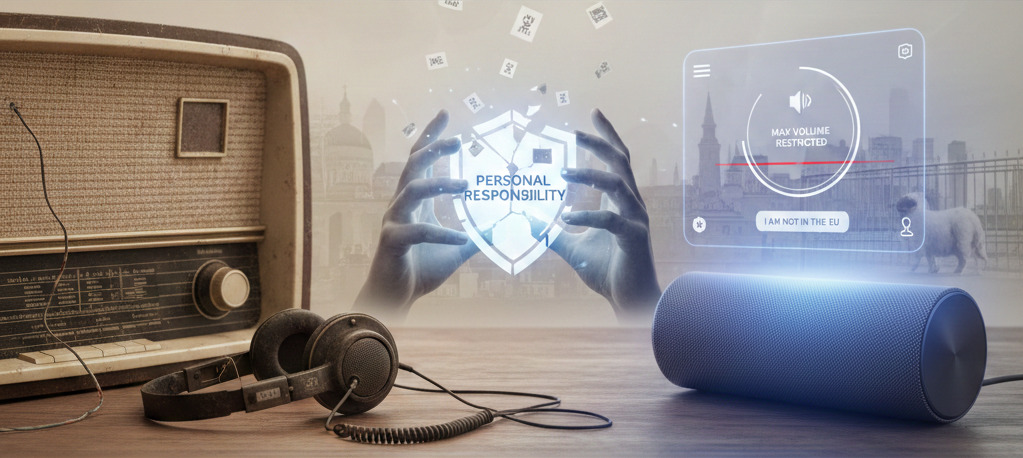
📜 The Bluetooth Decree
Earlier this week I saw a post about a seemingly trivial piece of EU regulation:
europe is not a real place pic.twitter.com/ykNOUcqumZ
— kitze 🛠️ tinkerer.club (@thekitze) February 4, 2026
“Are you located in the EU? If yes, max volume will be restricted. Yes/No”
On the surface, it’s about public safety. Protecting hearing. Preventing disturbance. But as I found myself in a discussion about it online, it became clear that my issue wasn’t really with the decibels, but about a fundamental shift in how we relate to our tools, our governments, and our responsibilities.
🤔 Public Health or Safety Theater?
Let’s give the regulators the benefit of the doubt - loud music can damage your hearing, and this is well-intended. But in this case circumventing the max volume is trivial. Of course the owner in the original post selected “No”. But even if you selected “Yes”, simply restarting the device brings up the prompt again.
With some other devices it’s just a warning once you go past a certain volume, gently nudging you to not listen at the max. Many young people genuinely don’t know that loud music is dangerous.
And this is what I’m really concerned about - parents are the ones who must bear primary responsibility for their children’s health. So why are they letting children habitually listen to loud music at 90-100dB for long periods of time? Work, chores, and stress leave many parents with less and less family time.
This decrease in parenting (and increase of threats to our children) is unfortunately leading us to delegate more and more of our traditional social structures to government.
✅ The Case for Localized Responsibility
First, let’s quickly tackle the safety issue - if we truly care about protecting hearing, we can solve this at a much more local level.
Instead of an easy to circumvent max volume, we could require that all standalone speakers allow customers to set their own limits. Say, a parental control setting protected by a password. Manufacturers can pre-set limits for safe sale to minors. Parents can limit the max volume for their kids. Audiophiles can blast their eardrums away at will.
This approach respects individual agency. It acknowledges that an adult using a speaker at a private outdoor event might need more power than a child in a bedroom. It moves the decision-making power from unelected bureaucrats in Brussels back to the citizen holding the device.
📈 The True Cost isn’t Financial, but Spiritual
There is, of course, a cost to any regulation. We pay the salaries of bureaucrats to write the rules. Then we pay engineers like myself to implement them, and companies pass that cost down to consumers. My proposal for password-protected max volume could be even more expensive than a simple yes/no prompt.
But more importantly, there is a spiritual toll. It’s the cost of being increasingly “parented” by our well-meaning governments.
When every risk is smoothed over by regulation, we lose the habit of personal responsibility. We might even stop thinking about “safe levels” because we assume the government has already done the thinking for us. What happens when we’re in a situation that doesn’t have this protection? Our car stereo, our old analog speakers, a loud concert?
We can’t pave the jungle - we have to put on some boots.
☠️ Death by a Thousand Cuts
A single regulation on Bluetooth speakers is a non-issue. It may even be a good thing, raising awareness of the dangers of loud noises. But over decades, such regulation is death by a thousand cuts from bureaucratic paper - each one a tiny slice of agency removed from us.
In my mind, this ties into the concept of human self-domestication. By removing all friction and risk from our environment through centralized decree, we are essentially domesticating ourselves. We become more docile, more dependent on the system, and less capable of navigating reality without a regulatory harness. This process has physical effects across many domesticated animals, including humans.
While these effects like having a lower aggression drive are not necessarily a bad thing, we have to preserve our competence and ability to think independently. Otherwise, when some part of the system inevitably fails catastrophically, we will find ourselves unable to function. The fate of human civilization may depend on the few who still can.